
A round replay does not establish a new accepted wager
Published — UTC

A replay can show the same dealt cards or bonus sequence again. Viewing it twice does not establish that a second wager was accepted or another award was credited.
Count accepted event identities
Assume an invented history records one accepted round, R-90, with a 1-unit stake and 3-unit return. The reader opens its replay twice. The account history still has only that one accepted round and one credit.
| Activity | Round identity | New accepted stake? |
|---|---|---|
| Original round | R-90 | 1 unit |
| First replay view | R-90 | No evidence of another |
| Second replay view | R-90 | No evidence of another |
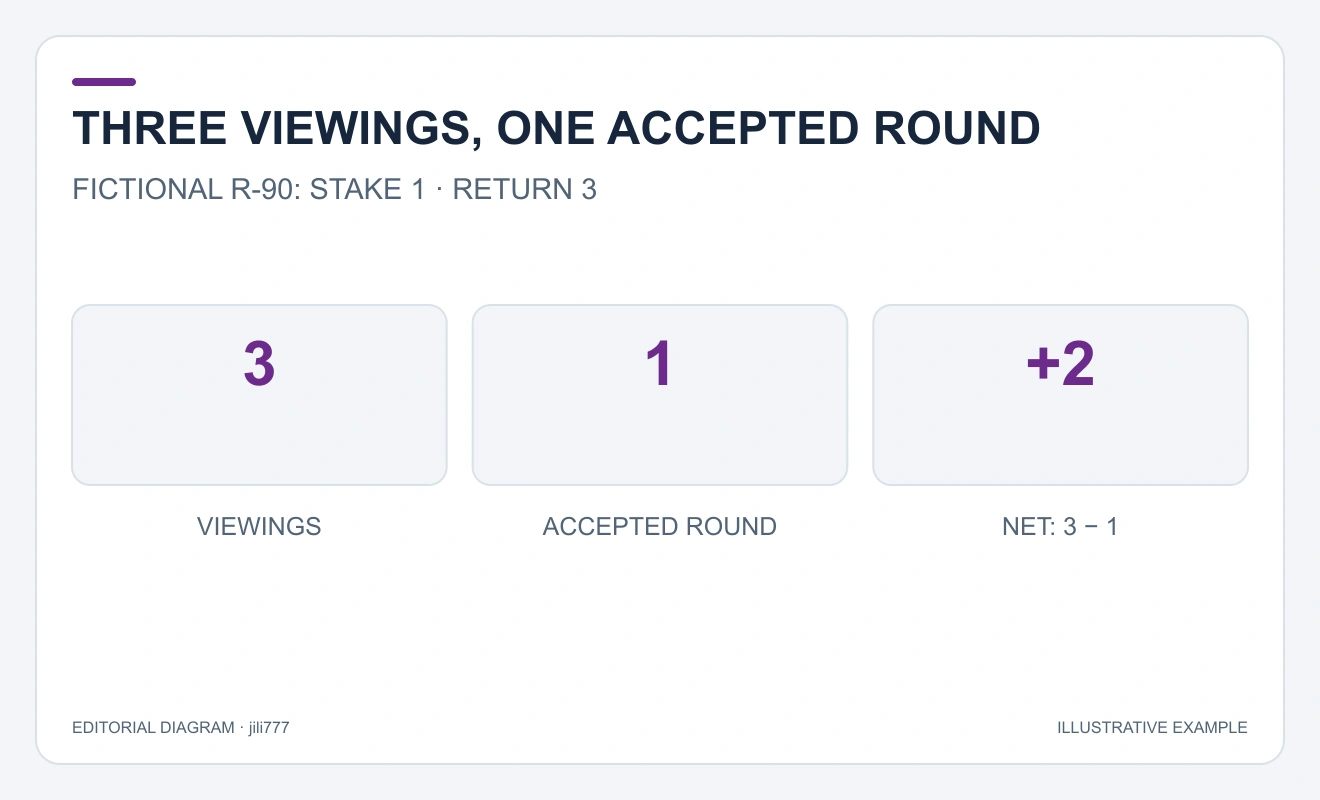
The example’s net remains 3 − 1 = 2 units. Multiplying the return by the three viewings would invent credits that the ledger does not contain.
A replay and a resume are different actions
A product may allow an incomplete game to resume at an unresolved step. That is not necessarily a read-only replay. Identify the action’s label and the round status rather than assuming every repeated animation is passive or every resumed display is a new wager.
The British interrupted-game reference supplies context for incomplete game states. It does not verify the behaviour of a particular replay control.
Rebuild the wallet from money records
Start the example at 10 units. One accepted stake of 1 leaves 9, and one confirmed return of 3 produces 12. Opening the replay twice adds no monetary entries in this model. Recording three returns against one stake would produce 18, while pretending there were three complete rounds would produce 16. Both disagree with the evidenced 12-unit wallet.
Do not deduplicate on a short label alone
The label R-90 may be unique only within one game or account history. If another game also uses R-90, its separately accepted record cannot be discarded just because the text matches. Retain the account scope, product, round identifier and the distinct transaction identifiers for stake and credit. A replay-view identifier is a viewing event, not a substitute for those transaction IDs.
Conversely, two exports can repeat the same confirmed credit transaction. Count that transaction once when combining overlapping exports. Different download times do not make the duplicated row a new award.
Updated history needs its own status
If the 3-unit return is later corrected to a final total of 2, the example wallet becomes 11. A replacement total of 2 and a linked adjustment of −1 are alternative representations; do not apply both. Keep the earlier version for the audit trail without counting both versions as separate settled returns.
A replay may omit an account-level adjustment, and an account ledger may not reproduce every visual step. Use each source for what it actually records. If a control resumes an unfinished choice or offers a new paid round, do not classify it as a passive replay from its animation alone. The accepted event and monetary records determine the count.