
An opening baccarat tie may disappear when the drawing rules finish
Two opening hands with four points each are equal at that moment. They do not automatically establish a final Tie result: the drawing rules may require more cards.
For the topic overview, see Tie outcome and separate bet rules.
Read the completed hand rather than treating the first equal totals as the settlement. A short worked deal shows exactly where that distinction matters.
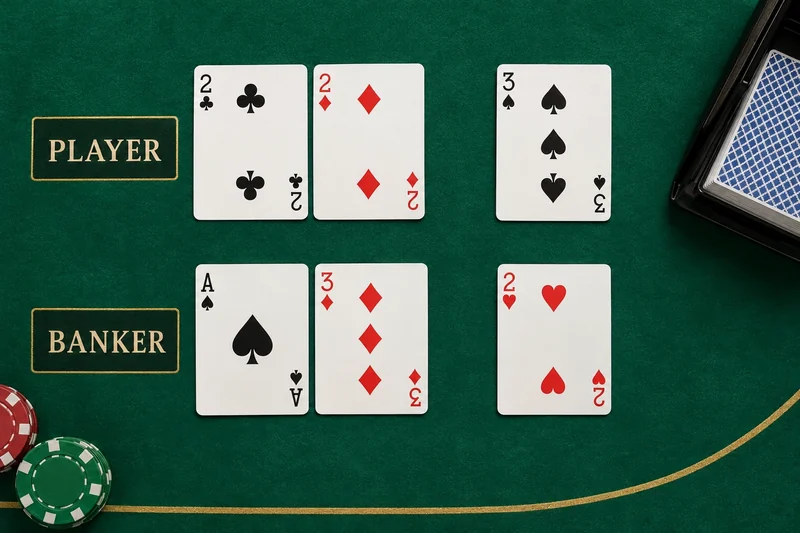
Separate the opening state from the completed hand
The City of Dreams Manila baccarat guide supplies the point-counting and drawing rules used here. This is a documented variant reference, not a claim that every side bet or other table has identical settlement terms.
Our invented opening cards are Player 2♣ and 2♦, and Banker A♠ and 3♦. Player totals four; Banker also totals four because the Ace counts as one. Neither hand is an opening natural eight or nine.
Continue the deal through the required draws
| Stage | Player cards and total | Banker cards and total |
|---|---|---|
| Opening | 2 + 2 = 4 | A + 3 = 4 |
| Player draws a 3 | 2 + 2 + 3 = 7 | Still 4 while awaiting its action |
| Banker draws a 2 | Final total 7 | 1 + 3 + 2 = 6 |
Player draws on the opening four. With Banker on four and Player’s third card a three, the cited tableau calls for Banker to draw. The invented additional Banker card is a two, leaving final totals seven and six. There is no final tie.
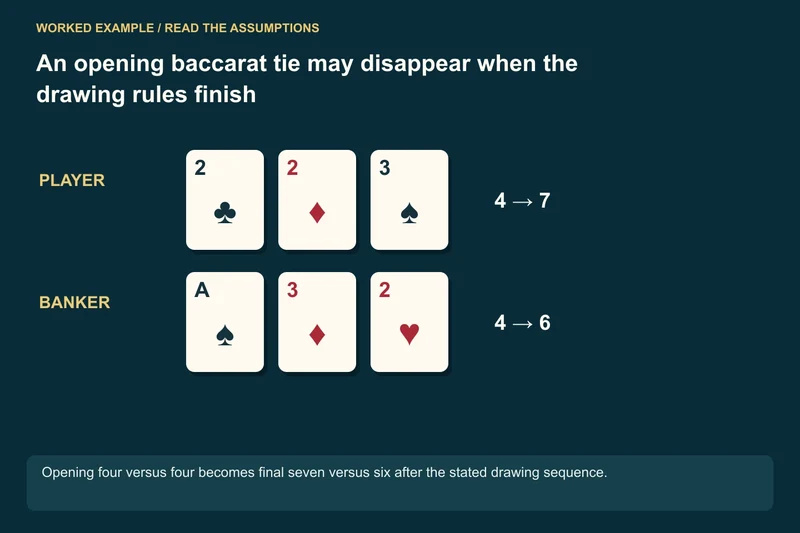
The word tie needs a time boundary
“The hands were tied” can accurately describe the opening image while inaccurately describing the completed round. Preserve the time or stage attached to the statement. An opening total, an intermediate total and a settled result answer different questions.
This distinction also prevents a misleading screenshot comparison. A still showing four versus four may have been captured before the third cards. It cannot prove that a later seven-versus-six record belongs to a different deal without checking the round identifier and sequence.
Check completion without inventing missing cards
For an existing record, retain the first two cards of each hand, any third cards, their order and the final result. If a card is missing from the evidence, mark it unknown; do not infer its rank merely because one final outcome would be more favorable.
The example is deliberately complete so the arithmetic and tableau can both be checked. It does not establish whether any Tie wager was placed, what odds it carried or how an unrelated side bet should pay. Those require their own accepted record and rules after the completed hand has been identified.
The jili777 homepage brings together the site’s other reading topics.
Source-based editorial research and original examples. Sources checked 9 October 2026. No real-money play or account transaction was performed for this article.